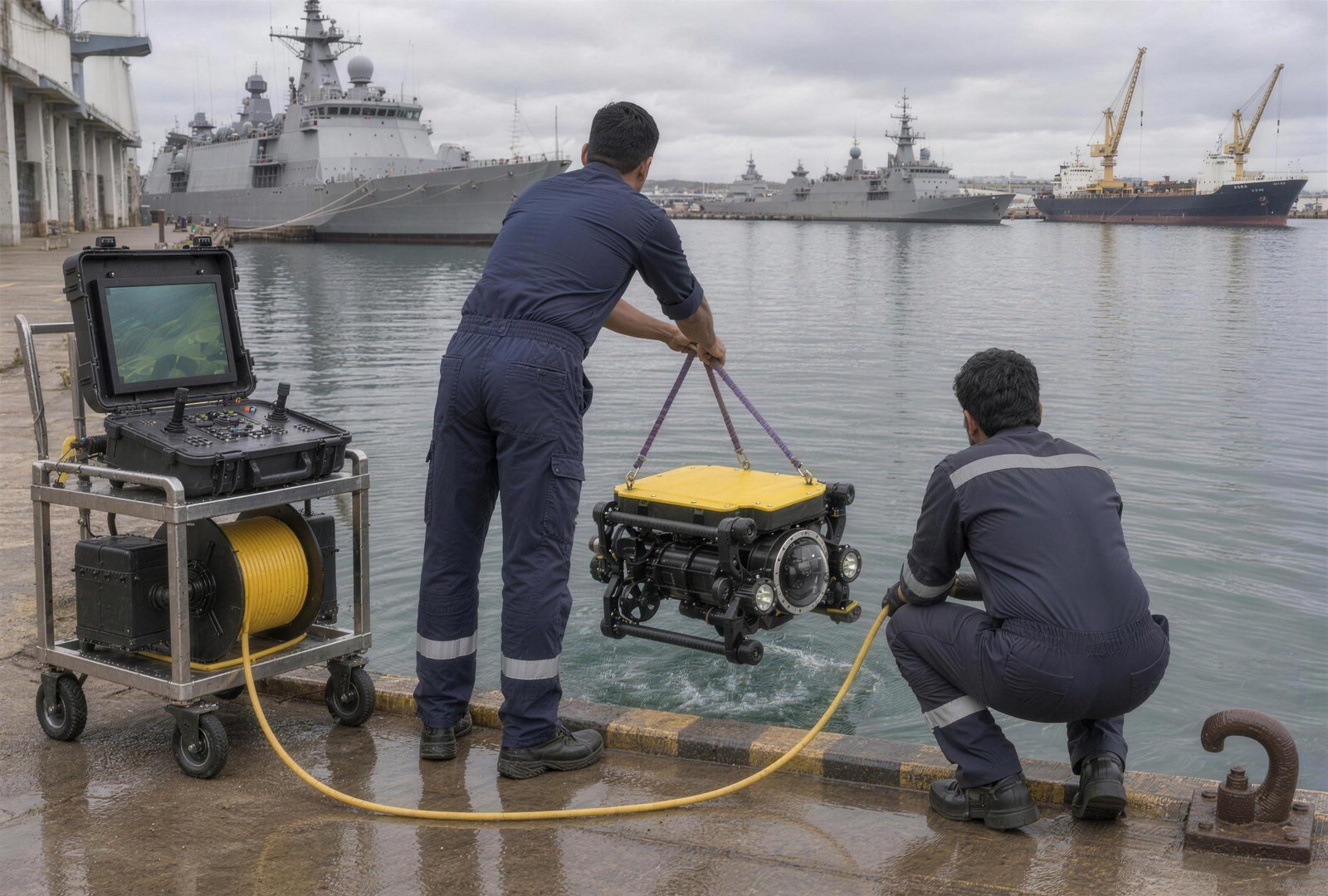
Harbour water is often murky, and a hull, a jetty pile or an intake is hard to check from the surface. A tethered underwater drone, called an ROV, lets a pilot on the jetty or the boat look at each of them on live video, with lights and sonar for the times a camera alone cannot see.
What harbour and hull inspection needs
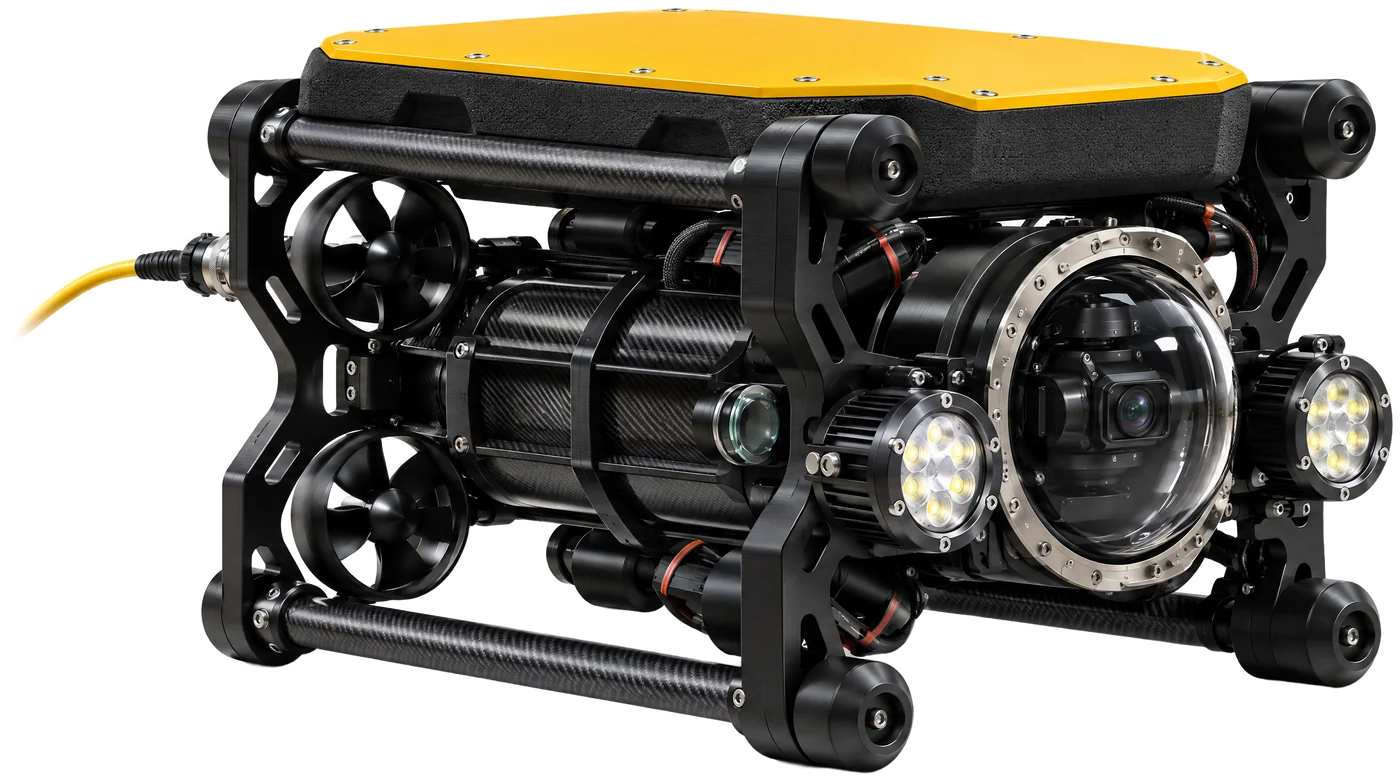
The job is close work in poor visibility: a clear picture of the hull or structure, a way to see when the water is dark, and a way to know where the vehicle is. The Thresher MKI is an observation-class ROV built for this kind of work.
- Live video. A 4K UHD colour camera with 30x optical zoom, 360° pan and 90° tilt, plus a 1080p HD and low-light monochrome secondary camera.
- Light and sonar for murky water. Variable lighting of up to 6,000 lumens and a 600-1200 kHz side-scan sonar, 150 m per side at 2 cm resolution.
- Position underwater. A 1 MHz DVL with bottom track to 100 m, and USBL tracking to 5,000 m, so the surface team knows where the vehicle is.
- Fine control. Six degrees of freedom and 25 kgf of thrust, to move along a hull or around a pile.
- Long dives. 8 hours of continuous dive on a 600 m fibre-optic hybrid tether with an automatic tether management system.
- Recovery of objects. An optional five-function electric arm lifts 8 kg.
What to specify
| Figure | Why it matters in a harbour | Thresher MKI |
|---|---|---|
| Depth rating | Covers berths, channels and deeper approaches | 300 m |
| Dive time | A full hull or a row of berths in one dive | 8 h continuous dive |
| Main camera | Detail on plates, welds, propellers and intakes | 4K UHD colour, 30x optical zoom; 360° pan, 90° tilt |
| Second camera | A picture in low light | 1080p HD + low-light monochrome |
| Lights | Murky water | Up to 6,000 lumens, variable |
| Sonar | Finding objects when the camera cannot see | 600-1200 kHz side-scan; 150 m per side, 2 cm resolution |
| Navigation | Knowing where the vehicle is | DVL 1 MHz, bottom track to 100 m; USBL tracking to 5,000 m |
| Tether | Reach from the jetty or the boat | 600 m fibre-optic hybrid with automatic TMS |
| Manoeuvring | Holding position beside a hull | 6 DOF, 25 kgf thrust, 10 knots max speed |
| Weight and size | Launch by a small crew | 35 kg; 750 x 420 x 350 mm |
| Manipulator (option) | Recovering an object | 5-function electric arm, 5 DOF, 8 kg lift |
| Control | The pilot's station | 24-inch HD touchscreen console, dual-axis joystick |
How an inspection dive works
- Plan the dive. Agree the hull, berth or structure to be checked with the harbour master or the ship's staff, and the position of the surface station.
- Set up the station. Place the surface control console and the tether drum on the jetty, the boat or the ship's side.
- Launch. The vehicle weighs 35 kg, so a small crew lowers it into the water with the tether on its automatic drum.
- Inspect. The pilot flies the vehicle along the hull or structure on live 4K video, using the lights, the low-light camera and the side-scan sonar where the water is dark.
- Track and record. DVL and USBL give the vehicle's position, so each finding can be noted against a place.
- Recover. Reel in the tether and lift the vehicle out. If an object must be brought up, the optional arm lifts up to 8 kg.
When an autonomous vehicle is the better choice
An ROV is the tool when a person needs to see and decide in real time. For repeated survey of a harbour on planned lines, an autonomous underwater vehicle does the work without a tether. Star INXS also builds a torpedo-form AUV, supplied only to Indian government and authorised defence users; details are shared through official channels.
Who it suits
The Thresher MKI is built for work like this. It suits:
- Navy dockyards, bases and ships that need hull, berth and mooring checks.
- Coast Guard stations and vessels that inspect hulls and search harbour beds.
- Port trusts and port authorities that inspect berths, jetty piles and intakes.
- CISF and other units that guard ports and waterfront installations.
- State marine police that check boats and landing points.
- SDRF and NDRF teams that search for and recover objects underwater.
- Dam, pipeline and offshore operators that inspect gates, intakes, pipelines and risers.
Buying it: manufacturer details, GeM and tenders
Star INXS designs and builds the Thresher MKI in India and is certified to five ISO management-system standards. You can buy through GeM, an open or limited tender, a defence portal or a direct purchase order.
Our Tender & GeM desk shares OEM authorisations, technical compliance statements and bid documents written against your specification.
- Send the requirement. Attach your tender specification or RFP to the quote request and we respond with a technical compliance statement.
- Ask for a budgetary quote. Prices depend on configuration and quantity. We reply within one business day.