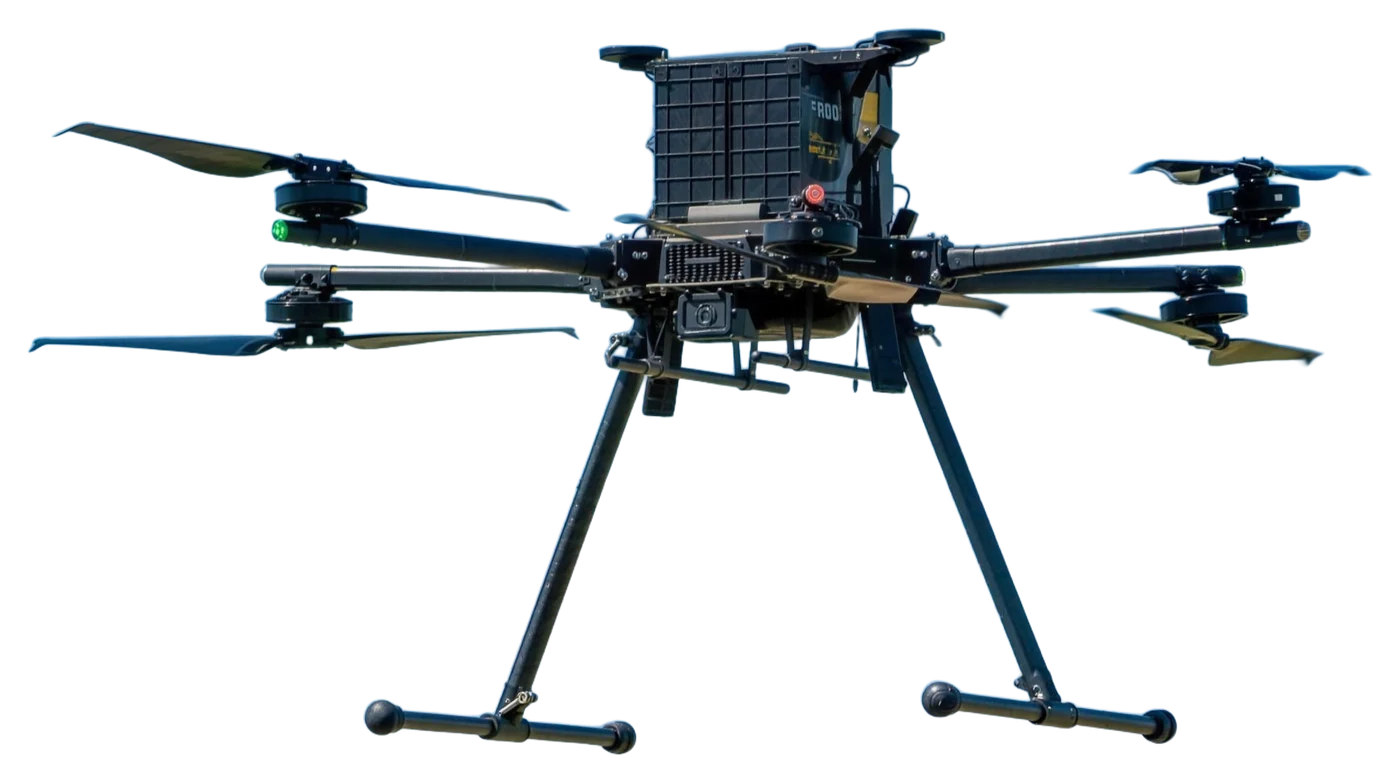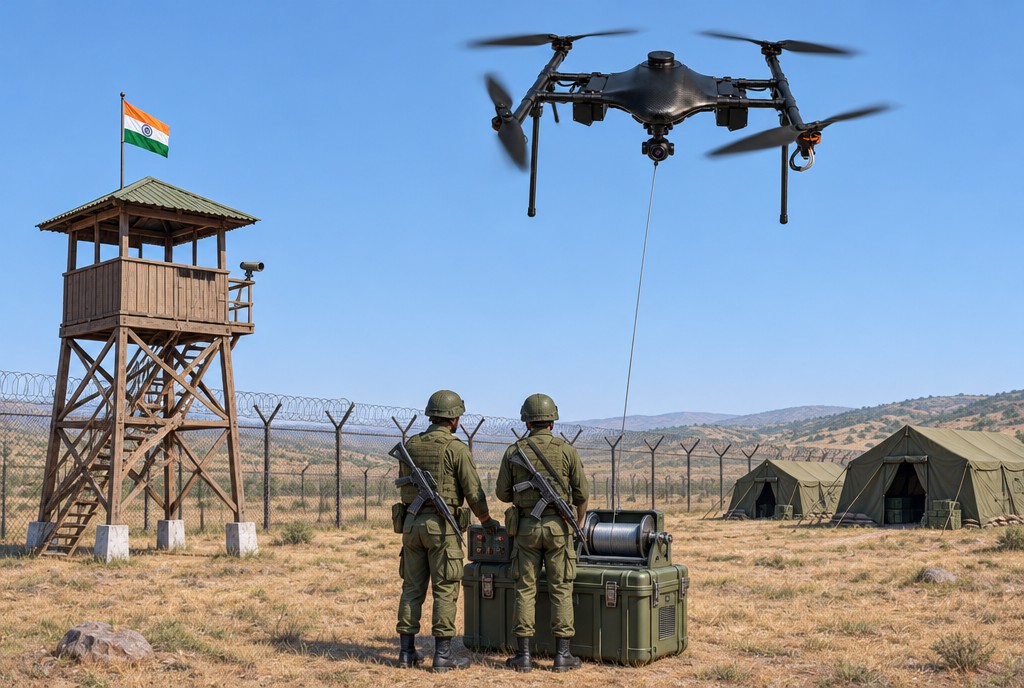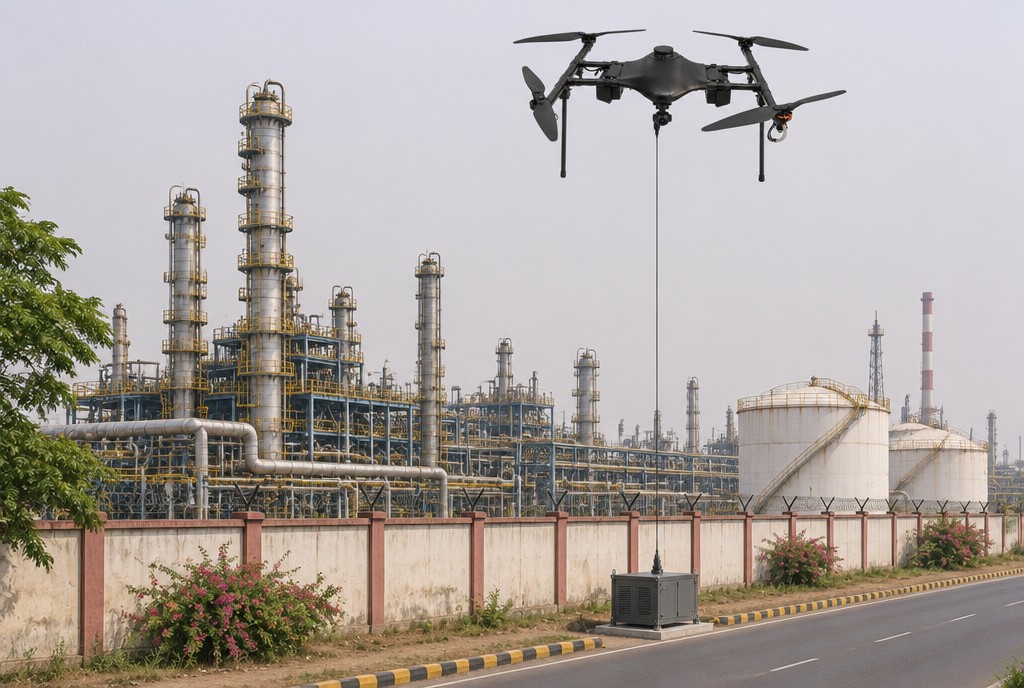
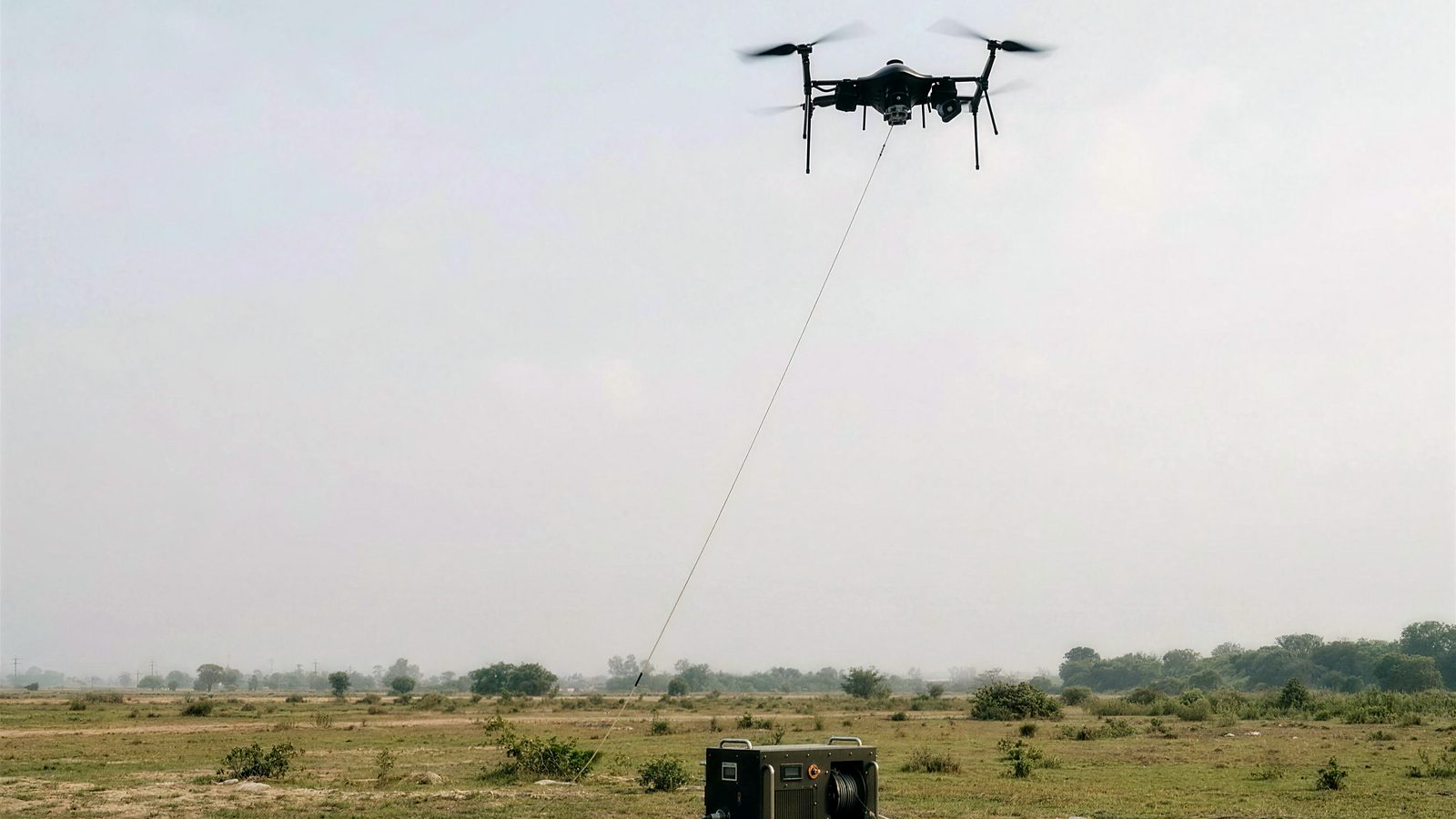
A festival, a rally or a match can run for many hours, and a camera that has to land every half hour leaves gaps. A tethered drone takes power through a cable from the ground, so it can stay above one place for the whole event and send live video over optical fibre rather than a radio link.
What a tethered drone adds to event security
Event control rooms need a steady, wide view: entrances, queues, exits and the roads around the venue. A free-flying drone gives that view for the length of its battery. A tethered drone gives it for the length of the event.
- Hours, not minutes. The Tethered Surveillance UAV flies 18-24 hours on ground power, so one aircraft covers a long event without battery swaps.
- A steady position. It hovers on a tether of 100 m or more, looking down on crowd flow rather than patrolling.
- No radio link. Control and video run over optical fibre, which suits venues where phones, radios and cameras already crowd the spectrum.
- Day and night. A 4K camera with 40x optical zoom and a 640 x 480 thermal/IR camera, both on a 3-axis gimbal, cover daylight and darkness.
- Distance to a point. The laser range finder (1,200 m) gives operators the range to a spot of interest in the crowd or around the venue.
What to specify
| Figure | Why it matters for an event | Tethered Surveillance UAV |
|---|---|---|
| Time aloft | Covers the whole event without landing | 18-24 h tethered, ground power |
| Tether length | Sets how much of the venue is in view | 100 m or more |
| Set-up time | Rigging before gates open | Under 15 min |
| Link | A crowded radio environment | Optical fibre, no radio link while operating |
| Cameras | Crowd flow by day, people at night | 4K, 40x zoom; thermal/IR 640 x 480; 3-axis gimbal |
| Range finder | Distance to a point of interest | Laser, 1,200 m |
| Safety | A cable or power fault must be flagged early | Tether monitoring, power-failure alerts, emergency recovery |
| Weight | Handling and transport | 12-15 kg all-up |
How a deployment works
- Survey the site. Choose a spot for the ground power box and winch with a clear view of the venue and room for the tether to rise, and agree the position with the event's safety and police teams.
- Check permissions. Drone use over crowds is governed by the DGCA rules and local authorities, so obtain what your venue requires before flying.
- Rig the station. The complete set (drone with payload, power box, winch, power cable, AC-to-DC power converter and ground power box) deploys in under 15 minutes, and the ground control station configures itself.
- Raise and monitor. The aircraft rises to its working position; operators watch the live feed and the tether and power status from the station and the control room.
- Recover. At the end of the event the winch reels the aircraft in, and the automatic flight log records the flight.
When a free-flying drone is the better choice
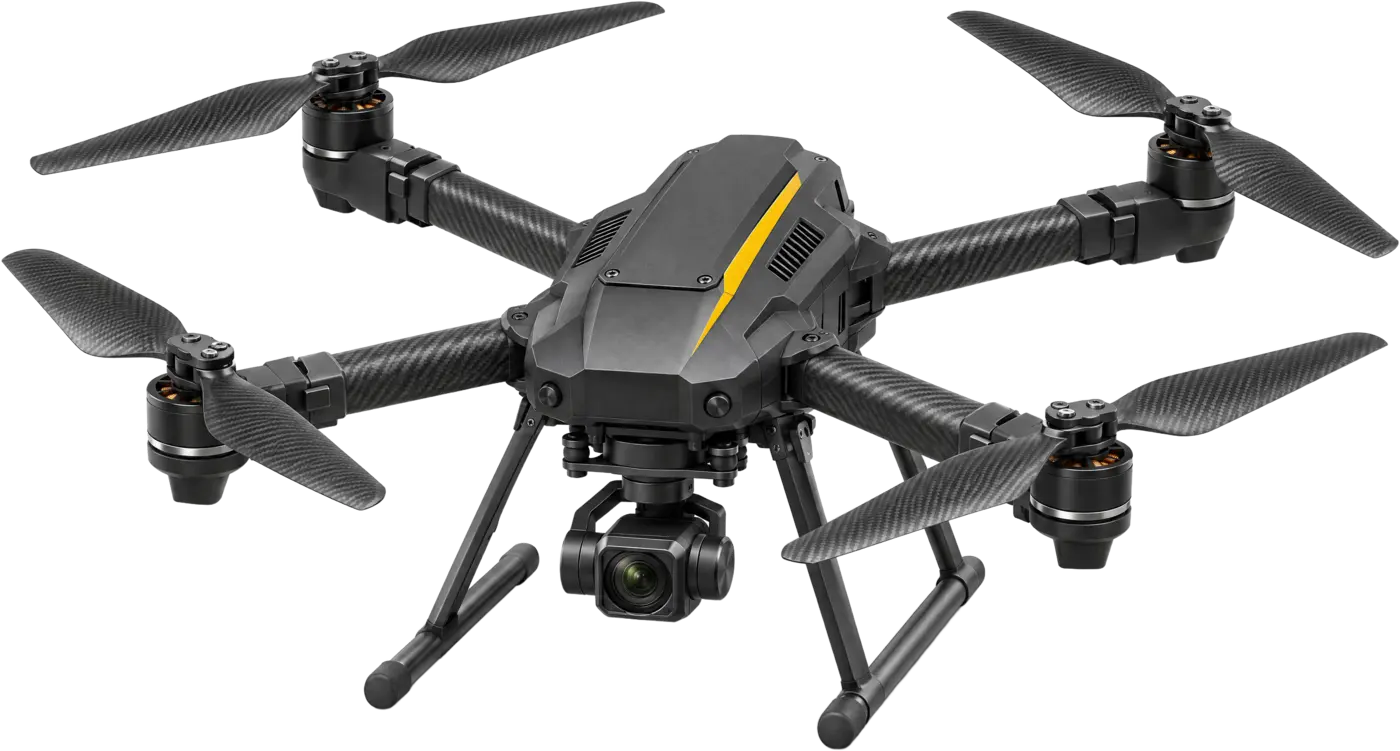
If the job is to follow a procession, search a wide area or cover several sites, a tether is a limit. A free-flying multicopter such as the MQ-750 MKIII (60 minutes, 10 km) moves where you need it. For the full comparison, read Tethered or free-flying?.
Who it suits
The Tethered Surveillance UAV is built for work like this. It suits:
- State, city and traffic police that cover rallies, festivals, processions and matches.
- CAPF units on crowd-management duty, such as CRPF and RAF.
- District administrations and municipal bodies that run large public events.
- Event organisers and security agencies that need a steady camera above one venue.
Buying it: manufacturer details, GeM and tenders
Star INXS designs and builds the Tethered Surveillance UAV in India and is certified to five ISO management-system standards. You can buy through GeM, an open or limited tender, a defence portal or a direct purchase order.
Our Tender & GeM desk shares OEM authorisations, technical compliance statements and bid documents written against your specification.
- Send the requirement. Attach your tender specification or RFP to the quote request and we respond with a technical compliance statement.
- Write or check the specification. Use the tender specification checklist to list the figures to ask for.
- Keep a one-page sheet. Download the PDF sheet for this use case to attach to your internal note.